
Content
- Overview
- Pre-conditions
- Steps
- Notes
Overview
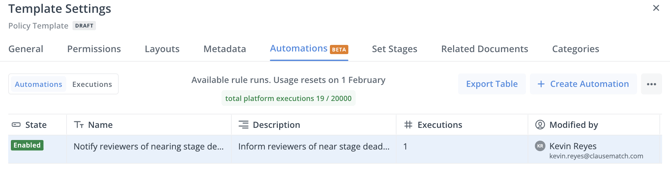
After creating and configuring automations on either a local or global scope (ie on the document/template or in Admin Panel), you can manage automations rules* by performing the below actions on them:
- Enable/disable.
- Duplicate.
- Delete.
- Export.
Additionally, you can get an overview of them with the following information:
- State.
- Name.
- Description.
- Executions.
- Created at.
- Created by.
- Modified at.
- Modified by.
Pre-conditions
Managing Automations on a Template/Document Level
- System Level Permission: [ 'System Administration' ] or [ 'Manage Automations' + ( 'Edit Documents' or 'Create Documents' or 'Document Manager' / 'Create Templates' )]
- Document/Template Level Permission: 'Owner', 'Editor', 'Reviewer', or 'Read Released'
Managing Automations on a Global Level
- System Level Permission: [ 'System Administration' ] or [ 'Manage Automations' + 'Document Manager']
Steps
Before proceeding with the core steps, there are 2 ways to manage an automation:
- Template/document level - Narrow scope
- Platform level - Wider scope, as this encompasses multiple elements (so across any combination of the document, template, or stage elements)
For the former, you have to go to the document or template (so you need direct access to it).
For the latter, you have to go to the Admin Panel module and navigate to the Automations tab.
Enable/Disable | Duplicate | Delete | Export
- (If on a document/template) Click on the
 icon in the top pane of the template/document.
 - To enable/disable, duplicate, or delete an automation rule:
- Scroll your mouse to the right of the relevant automation rule.
- Click on the
 icon.
icon. - Click any of the following:
- Enable/disable.
- Duplicate.
- Delete.
- To export the automation rules:
- Click on Export Table on top of the table.
Supplementary Information
Table Column Configurability
You can organize your table columns by:
- Hovering your mouse over a column.
- Clicking on its
 icon.
icon. - Choosing any of the following options:
- Pin left.
- Pin right.
- Hide column.
- Unpin.
Table Export
The CSV report will contain the same columns as the ones shown in your table view, so if needed, adjust your table columns.
Its filename format is as follows: "Automations - Month day, hour-minute.csv".
- Example: "Automations - July 7, 17-34.csv"
Notes
Template Automation Rules
- For documents created by a template, only through the template's Automations tab can the automation rules (that are executable on the associated documents) be shown.
Executions
- They reset each month.
- Exact date, used and total executions can be viewed in the Automations tab.
- During the Beta phase for this functionality, you will have unlimited automation rule executions.
- After the Beta phase, you will have a number of included executions per months according to your tariff.
For more information on this, please reach out to your company's Clausematch Customer Success Manager.
- After the Beta phase, you will have a number of included executions per months according to your tariff.
Metadata Date Notifications Migration
Metadata date notification settings before the deployment of 2024.1 to your platform have been automatically migrated to automation rules after 2024.1 deployment.
Users will need to configure the recipients and contents of the emails of the original metadata automation rule, and of any duplicates if duplicated before correction.
UAT Whitelisting
Only whitelisted users on the platform will receive notifications based on Automation configurations.
So you can safely test automations, and if applicable their duplicates, with your team without bothering other users.